In a wide-ranging conversation with TimelessNotes LIVE, Hohyun shares the story of his newest album, his mental health journey, and his distinctive creative process.
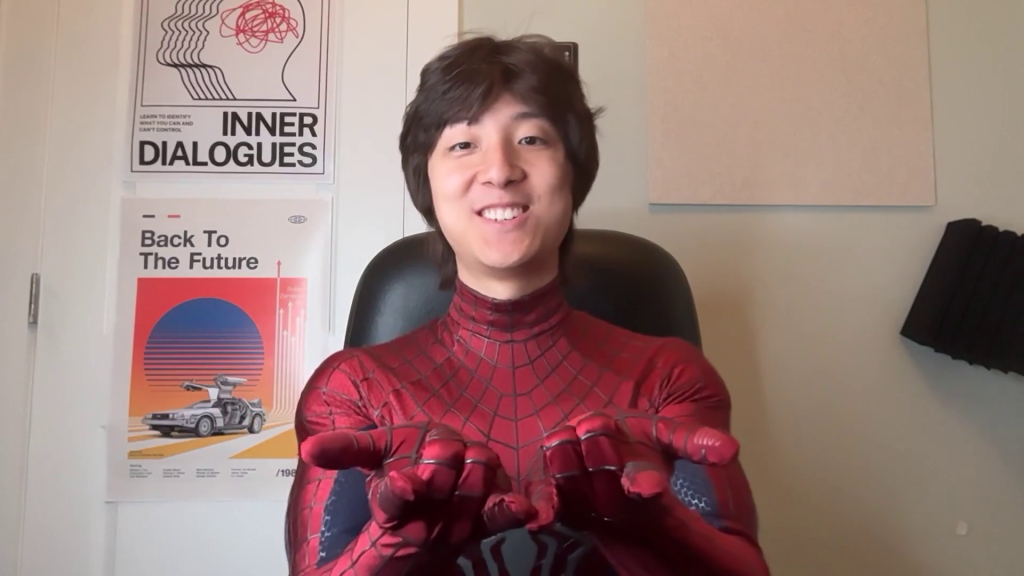
When Hohyun appears on screen, he’s not just a singer-songwriter talking about his new album — he’s Spider-Man.
Wearing a screen-accurate, movie-level Spider-Man suit (Andrew Garfield era, he specifies proudly), he grins into the camera and jokes that his “spidey senses are on every day.” It’s playful, a little disarming, and entirely human. Which makes sense. Because for Hohyun, connection isn’t an aesthetic choice — it’s the whole point.
The Korean-American artist joined TimelessNotes LIVE for a livestreamed conversation ahead of the release of his latest project, Petrichor, out November 11. The title is a reference to the earthy smell that rises when rain first hits dry ground — “the name of the chemical that’s released when rain hits the dirt,” he explains. “That smell you get when you can tell it’s rained or it’s about to rain. Humans are actually really attuned to it, so we can smell it from miles away.”
The word felt right, he says, because rain — and all that it represents — is at the heart of the album.
“There’s a very heavy theme of rain,” Hohyun says. “I didn’t even realize it at first. I was just writing songs as I was feeling things. But the rain became this stand-in for the depression I was going through.”
At first, Petrichor wasn’t even supposed to be an album. It was a lifeline.
Hohyun wrote track by track, not with a concept in mind, but as a way to document and process what he was living through. “The story of the album is just the story of my actual mental health,” he says. “What I was going through, and how I came to the realization that I needed help.”
Only later, when he lined up the songs, did he understand what he’d created: a chronological record of the moment he noticed he wasn’t okay, the numb repetition that followed, and the choice to ask for help anyway. “I realized, oh — this is a story,” he says. “And that just became the album.”
One of the most personal moments on Petrichor arrives in a track called “Tomorrow.” He quotes a line from the chorus:
“I thought tomorrow would be different, but it all just feels the same as it did yesterday.”
“It’s that feeling where everything’s in a loop,” he says. “Nothing feels like it’s getting better, but it’s also not getting worse. The days just melt together.”
Then comes the turn:
“I never thought I’d be the one to make a change, but here I am.”
That lyric was a promise to himself, he says — written right before he finally reached for help. “It started off very hopeless,” he admits. “And I think part of me was looking to go somewhere, so I wrote something more hopeful. I wrote that before I went and got help because I knew I was about to go and make a change.”
For Hohyun, that act — deciding to reach out — is something he wants other people, especially men, to feel unafraid to do.
He’s open about the fact that he struggled. He’s open about the fact that he needed help. And he’s open about why he’s talking about it publicly now.
“I want to help destigmatize conversations around mental health, especially for men — and especially Asian men,” he says. “I’d tell anyone who’s struggling that even if it’s hard to reach out, it’s worth doing. You never know who’s willing to listen.”
He’s honest about how impossible that first step can feel. “Sometimes you feel like maybe nobody wants to hear these things,” he says. “But you’d be surprised. Start with a friend. Just talk to someone. And then, slowly, try to figure out how to get professional help.”
That openness isn’t just branding. It’s how he processed his own experience.
“Creating is essential for me,” he says. “I didn’t have a lot of people to talk to. Making music and art was the only place I could put those feelings. Now I can look back on this project and see how far I’ve come in the past year and a half.”
If Petrichor is the journal, then Hohyun is both the subject and the archivist. That tracks — long before music became the center of his career, he studied filmmaking. He thought he’d be a director.
“Music was never supposed to be the main thing,” he laughs. “I was gonna be a filmmaker.”
That background shapes everything he does now. He doesn’t start a song with a chord or a lyric. He starts with a scene.
“I always approach music visually,” he explains. “I imagine a movie scene first, and then I make the music around that scene. I’m a very visual thinker — it’s almost like I make the music video before I make the song.”
That cinematic instinct gives Petrichor its mood: intimate, humid, close. You can feel the rain on your skin. You can feel the air right before you tell the truth.
And because Hohyun is fully independent — no label, no big machine — he’s able to build that world exactly the way he wants it.
“When you’re doing everything yourself, you don’t have to compromise on the vision,” he says. “That’s the most rewarding part of being independent. I can go from idea to execution and make it as close to what I imagined as possible.”
But that freedom comes with the obvious cost.
“The hardest part is… you have to do everything,” he says. Writing, recording, mixing, mastering, visuals, promotion — all of it. “It takes a lot of time and a lot of work. It’s a lot to juggle.”
He smiles a little when he admits he sets deadlines for himself so he’ll actually stop tweaking. Perfectionism, he suggests, is a moving target.
The version of him fans will see next is the live one.
Following the album release on November 11, he’s headed into a busy stretch of shows: a festival appearance in Arizona on November 29, followed by a December run of tour dates with longtime friend and collaborator Sarah Kang. They’ll be hitting six cities — Seattle, Los Angeles, San Francisco, Toronto, New York, and Chicago — and he lights up when he talks about it.
“I’m really excited,” he says. “Sarah’s basically like family. We’ve been in each other’s music journeys since the very beginning, so getting to tour together now is really special.”
Playing these songs live hits differently than recording them alone in his room.
“In the studio, it’s just me,” he says. “Me and my guitar, my computer. But performing is this whole other thing. I kind of lock in and almost black out while I’m on stage… and then afterward I get to talk to people. I feel like the best part of performance is actually after the fact when I get to hear from the audience what the performance meant to them.”
Fans have started treating him like something between a musician and a safe place. He doesn’t take that lightly.
“You’re kind of our therapist,” interviewer Yolanda tells him during the conversation. He laughs, but he doesn’t disagree.
By the end of the conversation, Hohyun has shown two sides of himself: the playful guy in a flawless Spider-Man suit, and the artist who is quietly, deliberately working to make it normal for men to say “I’m not okay and I need help.”
Maybe that’s why the rain matters. Not the storm — the after. That soft, almost-electric air that tells you you’re still here.
Petrichor drops November 11. Hohyun’s tour kicks off November 29 in Arizona, with December dates alongside Sarah Kang in Seattle, Los Angeles, San Francisco, Toronto, New York, and Chicago. If he’s in your city, you know where you’re supposed to be.
Follow Hohyun:
Instagram
Spotify
YouTube
If you are struggling, below are some U.S.-based mental health resources:
National Suicide Prevention Lifeline: 988
Crisis Text Line: Text HOME to 741741
Substance Abuse and Mental Health Services Administration (SAMHSA) National Helpline: 1-800-662-HELP (4357)


0 Comments